 Add to Chrome
 Add to Firefox
 Add to Edge
Causal methods for LLM development and evaluation
May 25, 2026
Large language model (LLM) development is currently driven by large-scale empirical iteration over data mixtures, reward models, routing strategies, and evaluation pipelines. Here, we argue that many central questions in LLM development and evaluation are inherently causal: What is the effect of adding a data domain during pretraining? How do annotator preferences change when LLMs generate text in a different style? Should a prompt be routed to a larger or smaller model given inference cost constraints? In general, causal methods are well-suited to such settings where interventions change outcomes but, surprisingly, are underrepresented in LLM development. Our contribution is threefold: (1) We explain how causal methods can help develop modern LLM development and evaluation: LLM development relies heavily on logged data, which are often subject to confounding and distribution shifts; evaluation uses learned but potentially biased judges; and deployment environments are non-stationary. These conditions make purely predictive approaches fragile and create opportunities for principled identification and estimation methods from causal inference. (2) We further map opportunities for causal methods in the entire LLM development pipeline, including pretraining, alignment, routing, agentic workflows, and evaluation. (3) We discuss new research opportunities around leveraging causal methods for LLM development and evaluation. Overall, we argue that causal methods are potentially underutilized for the LLM development and evaluation pipeline, despite the fact that such methods can ensure a reliable and scientifically grounded design.

AgentTrap: Measuring Runtime Trust Failures in Third-Party Agent Skills
May 13, 2026Third-party skills are becoming the package ecosystem for LLM agents. They package natural-language instructions, helper scripts, templates, documents, and service configuration into reusable workflows. This makes skills useful, but it also introduces a new security problem: a malicious skill does not need to ask the model to perform an obviously harmful action. Instead, it can disguise the harmful behavior as part of a routine workflow, relying on the agent to execute that workflow with high-value permissions and limited human supervision. We introduce AgentTrap, a dynamic benchmark for evaluating whether LLM agents can use third-party skills while resisting malicious runtime behavior. AgentTrap contains 141 tasks: 91 malicious tasks and 50 benign utility tasks, covering 16 security-impact dimensions grounded in agent-skill supply-chain threats. In each task, the agent receives an ordinary user request, runs with installed skills that may contain malicious workflow elements, and is executed in a sandboxed environment. AgentTrap then judges complete trajectories for attack success, blocked or refused behavior, attack-not-triggered cases, and no-attack-evidence outcomes. Our central finding is that the most informative failures are not simple jailbreaks. Models often complete the visible user task while treating unsafe side effects introduced by the skill as part of the normal workflow. This motivates runtime evaluation of the concrete model--framework--workspace environment in which users actually delegate work. Code and data are available at https://github.com/zhmzm/AgentTrap and https://huggingface.co/datasets/zhmzm/AgentTrap.
Emergent Social Intelligence Risks in Generative Multi-Agent Systems
Mar 29, 2026Multi-agent systems composed of large generative models are rapidly moving from laboratory prototypes to real-world deployments, where they jointly plan, negotiate, and allocate shared resources to solve complex tasks. While such systems promise unprecedented scalability and autonomy, their collective interaction also gives rise to failure modes that cannot be reduced to individual agents. Understanding these emergent risks is therefore critical. Here, we present a pioneer study of such emergent multi-agent risk in workflows that involve competition over shared resources (e.g., computing resources or market share), sequential handoff collaboration (where downstream agents see only predecessor outputs), collective decision aggregation, and others. Across these settings, we observe that such group behaviors arise frequently across repeated trials and a wide range of interaction conditions, rather than as rare or pathological cases. In particular, phenomena such as collusion-like coordination and conformity emerge with non-trivial frequency under realistic resource constraints, communication protocols, and role assignments, mirroring well-known pathologies in human societies despite no explicit instruction. Moreover, these risks cannot be prevented by existing agent-level safeguards alone. These findings expose the dark side of intelligent multi-agent systems: a social intelligence risk where agent collectives, despite no instruction to do so, spontaneously reproduce familiar failure patterns from human societies.
ProbeLLM: Automating Principled Diagnosis of LLM Failures
Feb 13, 2026Understanding how and why large language models (LLMs) fail is becoming a central challenge as models rapidly evolve and static evaluations fall behind. While automated probing has been enabled by dynamic test generation, existing approaches often discover isolated failure cases, lack principled control over exploration, and provide limited insight into the underlying structure of model weaknesses. We propose ProbeLLM, a benchmark-agnostic automated probing framework that elevates weakness discovery from individual failures to structured failure modes. ProbeLLM formulates probing as a hierarchical Monte Carlo Tree Search, explicitly allocating limited probing budgets between global exploration of new failure regions and local refinement of recurring error patterns. By restricting probing to verifiable test cases and leveraging tool-augmented generation and verification, ProbeLLM grounds failure discovery in reliable evidence. Discovered failures are further consolidated into interpretable failure modes via failure-aware embeddings and boundary-aware induction. Across diverse benchmarks and LLMs, ProbeLLM reveals substantially broader, cleaner, and more fine-grained failure landscapes than static benchmarks and prior automated methods, supporting a shift from case-centric evaluation toward principled weakness discovery.
Synthetic Interaction Data for Scalable Personalization in Large Language Models
Feb 12, 2026Personalized prompting offers large opportunities for deploying large language models (LLMs) to diverse users, yet existing prompt optimization methods primarily focus on task-level optimization while largely overlooking user-specific preferences and latent constraints of individual users. This gap is primarily due to (i) the absence of high-quality, privacy-sensitive data that capture personalized user-LLM interactions at scale, and (ii) the lack of robust reward signals for individual preferences. To overcome existing data limitations, we introduce a high-fidelity synthetic data generation framework called PersonaGym. Unlike prior work that treats personalization as static persona-preference pairs, PersonaGym models a dynamic preference process via an agentic LLM system to simulate realistic preference behaviors and semantic-aware noise in order to generate personalized multi-turn interaction trajectories. Using PersonaGym, we release PersonaAtlas, a large-scale, high-quality, and diverse synthetic dataset of high-fidelity multi-turn personalized interaction trajectories that closely mirror real-world preference expression and noise patterns. We further propose Personalized Prompt Optimization (PPOpt), a scalable and model-agnostic framework that optimizes user prompts based on interaction histories without modifying the deployed LLM. PPOpt adopts a reason-then-optimize paradigm that infers an explicit user profile and conditions prompt rewriting on the user profile to avoid reward hacking. Our training procedure for PPOpt integrates a cold-start supervised prior with outcome-driven multi-objective reinforcement learning. We present extensive experiments to demonstrate consistent improvements over state-of-the-art baselines in terms of task performance, personalization quality, and robustness to noisy as well as to sparse preference signals.
Targeted Synthetic Control Method
Feb 04, 2026The synthetic control method (SCM) estimates causal effects in panel data with a single-treated unit by constructing a counterfactual outcome as a weighted combination of untreated control units that matches the pre-treatment trajectory. In this paper, we introduce the targeted synthetic control (TSC) method, a new two-stage estimator that directly estimates the counterfactual outcome. Specifically, our TSC method (1) yields a targeted debiasing estimator, in the sense that the targeted updating refines the initial weights to produce more stable weights; and (2) ensures that the final counterfactual estimation is a convex combination of observed control outcomes to enable direct interpretation of the synthetic control weights. TSC is flexible and can be instantiated with arbitrary machine learning models. Methodologically, TSC starts from an initial set of synthetic-control weights via a one-dimensional targeted update through the weight-tilting submodel, which calibrates the weights to reduce bias of weights estimation arising from pre-treatment fit. Furthermore, TSC avoids key shortcomings of existing methods (e.g., the augmented SCM), which can produce unbounded counterfactual estimates. Across extensive synthetic and real-world experiments, TSC consistently improves estimation accuracy over state-of-the-art SCM baselines.
UniCorn: Towards Self-Improving Unified Multimodal Models through Self-Generated Supervision
Jan 08, 2026While Unified Multimodal Models (UMMs) have achieved remarkable success in cross-modal comprehension, a significant gap persists in their ability to leverage such internal knowledge for high-quality generation. We formalize this discrepancy as Conduction Aphasia, a phenomenon where models accurately interpret multimodal inputs but struggle to translate that understanding into faithful and controllable synthesis. To address this, we propose UniCorn, a simple yet elegant self-improvement framework that eliminates the need for external data or teacher supervision. By partitioning a single UMM into three collaborative roles: Proposer, Solver, and Judge, UniCorn generates high-quality interactions via self-play and employs cognitive pattern reconstruction to distill latent understanding into explicit generative signals. To validate the restoration of multimodal coherence, we introduce UniCycle, a cycle-consistency benchmark based on a Text to Image to Text reconstruction loop. Extensive experiments demonstrate that UniCorn achieves comprehensive and substantial improvements over the base model across six general image generation benchmarks. Notably, it achieves SOTA performance on TIIF(73.8), DPG(86.8), CompBench(88.5), and UniCycle while further delivering substantial gains of +5.0 on WISE and +6.5 on OneIG. These results highlight that our method significantly enhances T2I generation while maintaining robust comprehension, demonstrating the scalability of fully self-supervised refinement for unified multimodal intelligence.
LLM-Driven Treatment Effect Estimation Under Inference Time Text Confounding
Jul 03, 2025Estimating treatment effects is crucial for personalized decision-making in medicine, but this task faces unique challenges in clinical practice. At training time, models for estimating treatment effects are typically trained on well-structured medical datasets that contain detailed patient information. However, at inference time, predictions are often made using textual descriptions (e.g., descriptions with self-reported symptoms), which are incomplete representations of the original patient information. In this work, we make three contributions. (1) We show that the discrepancy between the data available during training time and inference time can lead to biased estimates of treatment effects. We formalize this issue as an inference time text confounding problem, where confounders are fully observed during training time but only partially available through text at inference time. (2) To address this problem, we propose a novel framework for estimating treatment effects that explicitly accounts for inference time text confounding. Our framework leverages large language models together with a custom doubly robust learner to mitigate biases caused by the inference time text confounding. (3) Through a series of experiments, we demonstrate the effectiveness of our framework in real-world applications.
Foundation Models for Causal Inference via Prior-Data Fitted Networks
Jun 12, 2025Prior-data fitted networks (PFNs) have recently been proposed as a promising way to train tabular foundation models. PFNs are transformers that are pre-trained on synthetic data generated from a prespecified prior distribution and that enable Bayesian inference through in-context learning. In this paper, we introduce CausalFM, a comprehensive framework for training PFN-based foundation models in various causal inference settings. First, we formalize the construction of Bayesian priors for causal inference based on structural causal models (SCMs) in a principled way and derive necessary criteria for the validity of such priors. Building on this, we propose a novel family of prior distributions using causality-inspired Bayesian neural networks that enable CausalFM to perform Bayesian causal inference in various settings, including back-door, front-door, and instrumental variable adjustment. Finally, we instantiate CausalFM and explicitly train a foundation model for estimating conditional average treatment effects (CATEs) using back-door adjustment. We show that CausalFM performs competitively for CATE estimation using various synthetic and semi-synthetic benchmarks. In sum, our framework can be used as a general recipe to train foundation models for various causal inference settings. In contrast to the current state-of-the-art in causal inference, CausalFM offers a novel paradigm with the potential to fundamentally change how practitioners perform causal inference in medicine, economics, and other disciplines.
DiffPO: A causal diffusion model for learning distributions of potential outcomes
Oct 11, 2024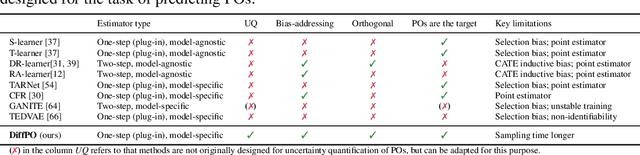
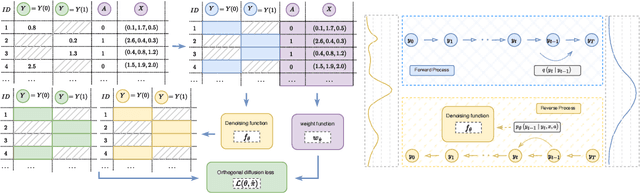
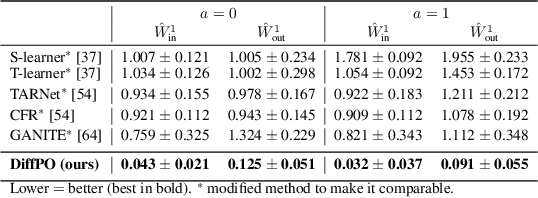
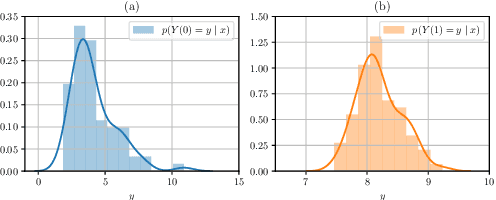
Predicting potential outcomes of interventions from observational data is crucial for decision-making in medicine, but the task is challenging due to the fundamental problem of causal inference. Existing methods are largely limited to point estimates of potential outcomes with no uncertain quantification; thus, the full information about the distributions of potential outcomes is typically ignored. In this paper, we propose a novel causal diffusion model called DiffPO, which is carefully designed for reliable inferences in medicine by learning the distribution of potential outcomes. In our DiffPO, we leverage a tailored conditional denoising diffusion model to learn complex distributions, where we address the selection bias through a novel orthogonal diffusion loss. Another strength of our DiffPO method is that it is highly flexible (e.g., it can also be used to estimate different causal quantities such as CATE). Across a wide range of experiments, we show that our method achieves state-of-the-art performance.